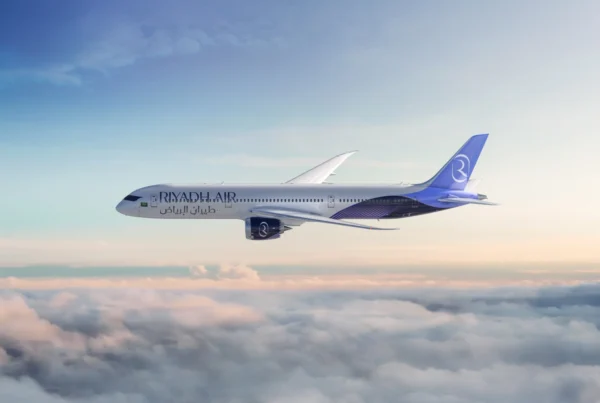



Yesterday marked an historic milestone. Riyadh Air, the world’s first digitally native airline, took flight. No PSS, no legacy constraints. This is the first full-service carrier built entirely on an Offer & Order foundation. For the past month, Riyadh Air has been in production, processing live orders. Every price shown, every offer created, and every order fulfilled runs on FLYR’s architecture.
This moment goes beyond a first flight. It shows that what the industry viewed as a long-term goal is finally real.
Our first step wasn’t to build. It was agreeing on the design principles that would guide every decision, knowing how easily ideals get compromised once the work begins. We’re fortunate to have a customer who shared those values and stayed committed, even when time pressures and complexity made it easier not to.
These design principles became our guardrails – not constraints that slowed us down, but clarity that let us move faster. When every decision traces back to removing friction, making data trustworthy, and building for AI, tough choices become obvious. Over the next six months, we will dig into these principles and show why they matter while remaining grounded in the reality of launching a fully fledged airline.
This way of working isn’t just about FLYR or even our customers. It’s about doing what’s right for an industry on the brink of change. That can be hard, especially when tempted by shortcuts, quick fixes, or superficial solutions. Designed to Deliver is more than a slogan. It’s how we govern every choice.
What “Designed to Deliver” Means
We built Offer & Order to move the industry forward, not to recreate what already existed with new labels. From the start, we decided that adopting standards was not enough. As the first to make this work in production, we have a responsibility to lead and inform those standards, not simply follow them. Every product decision we make ties back to three core themes that keep us aligned and moving forward.
1. Removing the Friction
Real delivery means working together. Our architecture removes friction between systems and partners, making it easier to adapt, integrate, and grow as the industry evolves.
- ONE Order Readiness and Modular and Future Proof design let airlines deploy Offer & Order capabilities step by step, not through risky all-at-once replacements.
- Seamless Legacy Transition ensures compatibility across partners still running on older systems. That flexibility accelerates delivery for everyone involved.
2. Data You Can Work With
Airlines already sit on an incredible amount of data. The problem isn’t that the data is wrong, it’s that it’s often incomplete, outdated, or hard to use. For that data to reach its potential, everyone accessing it needs to trust that it’s recent, complete, and structured in a way that makes sense.
- Single Source of Truth means every piece of data and every decision in an Offer or Order comes from one authoritative source. Traditionally, pricing, products, stock, and payments often live in multiple systems, creating inconsistency, complexity, and revenue leakage. Our goal is to make each data element originate from one place, delivering predictability, simplicity, and trust across the entire ecosystem.
- Track Commercial Impacts ties every order change back to its outcome, creating a clear and measurable view of how decisions translate to revenue and results.
3. Building for an AI World
To build for an unpredictable future, systems must be open and transparent enough to let automation and intelligence work safely.
- API First and No Closed or Hidden Data are about freeing information. For too long, airline data has been slow, unstructured, and locked away. That changes here. Data now moves freely and securely, available the moment it’s created, ready for AI to learn from and for APIs to act on. Openness turns information into intelligence and keeps innovation moving.
- Security and Privacy by Design keeps that openness responsible, protecting airlines and travelers alike.
These principles stop us from standing still as an industry. We could have achieved Offer & Order faster and cheaper with workarounds, but that would have trapped us in the same limitations we were trying to move beyond. Taking shortcuts might deliver short-term wins, but it would make every future roadmap a fantasy.
The Architectural Edge
When we set out to build Offer & Order, we made a few choices that shaped everything that followed. We decided that architecture, not workarounds, would define delivery.
That meant creating a system where product, pricing, and servicing are all accessible from a unified source. The Order became the single, reliable record that connects every part of the retail process, from what was sold to how it’s serviced, settled and fulfilled. No more juggling between PSS, merchandising, and accounting systems trying to reconcile the same transaction.
We could have gone faster by layering new interfaces over old logic, but that would have kept the same fragmentation beneath the surface. Instead, we built a framework fully aligned with ONE Order standards, unified, structured, and ready to grow.
In this architecture, Offer Orchestration handles what’s being sold, and the Order captures everything that’s been sold. The two work together as a continuous loop, every sale traceable, every change visible in real time. Airlines and travelers operate from the same information, reducing confusion and rework.
That clarity has a measurable impact. When product, price, and fulfillment all speak the same language, introducing something new (a fare bundle, seat type, or third-party product) no longer means rebuilding downstream systems or retraining staff. The connections are already there.
That’s why adding a new product now takes minutes instead of months. The hard work happened upfront, in the architecture itself. Once the foundation is clean, progress moves fast.
No Airline Is an Island
Every airline must operate in an ecosystem that still depends on legacy systems and long-established standards. Ignoring that reality helps no one.
We built for it.
Through the Legacy Translator, we maintain real-time, two-way communication between modern Offer & Order APIs and traditional formats like EDIFACT and PSS messaging. That bridge keeps airlines connected while still moving forward, and ensures fundamental capabilities such as selling through the GDSs or supporting codeshare and interline partnerships.
This work also taught us what transitioning airlines will need. Building Offer & Order to run with legacy systems in production meant solving the hardest part first: interoperability. It gave us an inside view of what a gradual, low-risk transition looks like for larger carriers that can’t start from a blank slate.
Using that experience, we’ve built several true Offer and Order solutions designed to function within a current PSS environment. Seamless Servicing, Personalized Offers, and Cart all work today inside mixed architectures, proving that modernization doesn’t have to wait for legacy to disappear.
Legacy technology carried this industry for fifty years, and still handles some extremely sophisticated purchases. Our goal isn’t to replace it overnight but to make the path forward clear. The architecture we’ve built allows airlines to modernize at their own pace, stay compatible with partners, and plan confidently for the day they can let legacy rest.
No One Told Our Teams it Couldn’t Be Done
People ask how we built and delivered this so fast. The answer is simple, but not easy.
We build like a modern software company. Small teams of highly talented engineers, native to new technologies, lead by people with a deep understanding of the industry with direct communication and decisions made by the people doing the work. There’s no legacy codebase or sacred revenue streams to protect. That freedom lets us focus entirely on solving the problem in front of us.
Riyadh Air wanted a partner who could move fast and make decisions based on principle, not habit. That alignment made real progress possible.
We also played a coordination role, helping other vendors stay aligned and making sure every part of the system connected cleanly. Our principles created focus without the bureaucracy that usually slows large projects down.
When teams share context and stay close to the work, they move faster and build better. That’s how we reached production in months instead of years.
A Proud Moment for All of Us
The first native Offer & Order transaction went live on October 8. Today, Riyadh Air begins service as the first airline built from the ground up on Offer & Order.
We’re honored to be at the forefront of this shift and to see it working in the real world. This isn’t a demo or a trial. It’s a live airline, fully operational, selling, servicing, and fulfilling every product through one unified system.
In the coming months, when Riyadh Air goes live to the general public, travelers will see a Cart that lets them save and build their complete trips in one place. Every Cart can create a complete order before checkout, capturing every item in the journey within a single record. GDS integrations are already live through the Legacy Translator, connecting Offer & Order with partners still operating on legacy systems. This is not theory. It’s working, end to end, across every channel.
Offer & Order is no longer an idea waiting to be proven. It is proven and it’s an opportunity for us all. The foundation is here, and it works. Now the focus shifts to what comes next: adapting this model to meet each airline’s unique challenges and continuing to show, again and again, that the right design delivers.
Looking Forward
People like to say building Offer & Order for a new airline is easier. Maybe on paper. But in practice, it was the hardest way to prove it works.
We had no safety net, no fallbacks, no years-long transition plan to lean on. The timelines were tight, and the stakes were high. Every decision was new. Questions that had never been asked before in this industry had to be answered, and answered fast. That’s what it took to get a true Offer & Order airline in the air.
Doing it this way forced us to make decisions that will make it easier for every airline that follows. The same principles that shaped Riyadh Air’s foundation are now the playbook for airlines modernizing their systems step by step. The framework is proven. The architecture works. And it’s ready to meet each airline where they are.