


Why it matters
AI adoption in travel is no longer a model problem. It is an infrastructure problem. Agentic systems will favor platforms that support full, end-to-end transactions, including changes and servicing. When commercial systems remain fragmented, agents hit technical limits and move elsewhere.
Traditional travel APIs are the limiting factor in AI adoption
AI is already interacting with airline systems, at least it is trying to. Not as a traveler clicking through pages or an agent stepping through a script, but as software that explores options, weighs tradeoffs, revises plans, and acts on behalf of a traveler – often many times within a single interaction.
Compared to the linear, stateless nature of an IBE, this fundamentally changes what is being asked of airline systems.
AI can reason across price, flexibility, loyalty value, and timing. It can revise plans mid-conversation. It can explore alternatives without losing the thread. Traditional airline APIs, in many cases, cannot. And when they fall short, AI guesses – or finds an alternative solution somewhere else.
Most Airline APIs were designed for linear transactions. They reset context between calls. They separate shopping from servicing. They treat booking, change, and fulfillment as different worlds. When those boundaries are hit, AI works around them or finds an alternative solution elsewhere.
The ceiling AI hits isn’t intelligence. It’s infrastructure.
What agentic travel looks like when it works
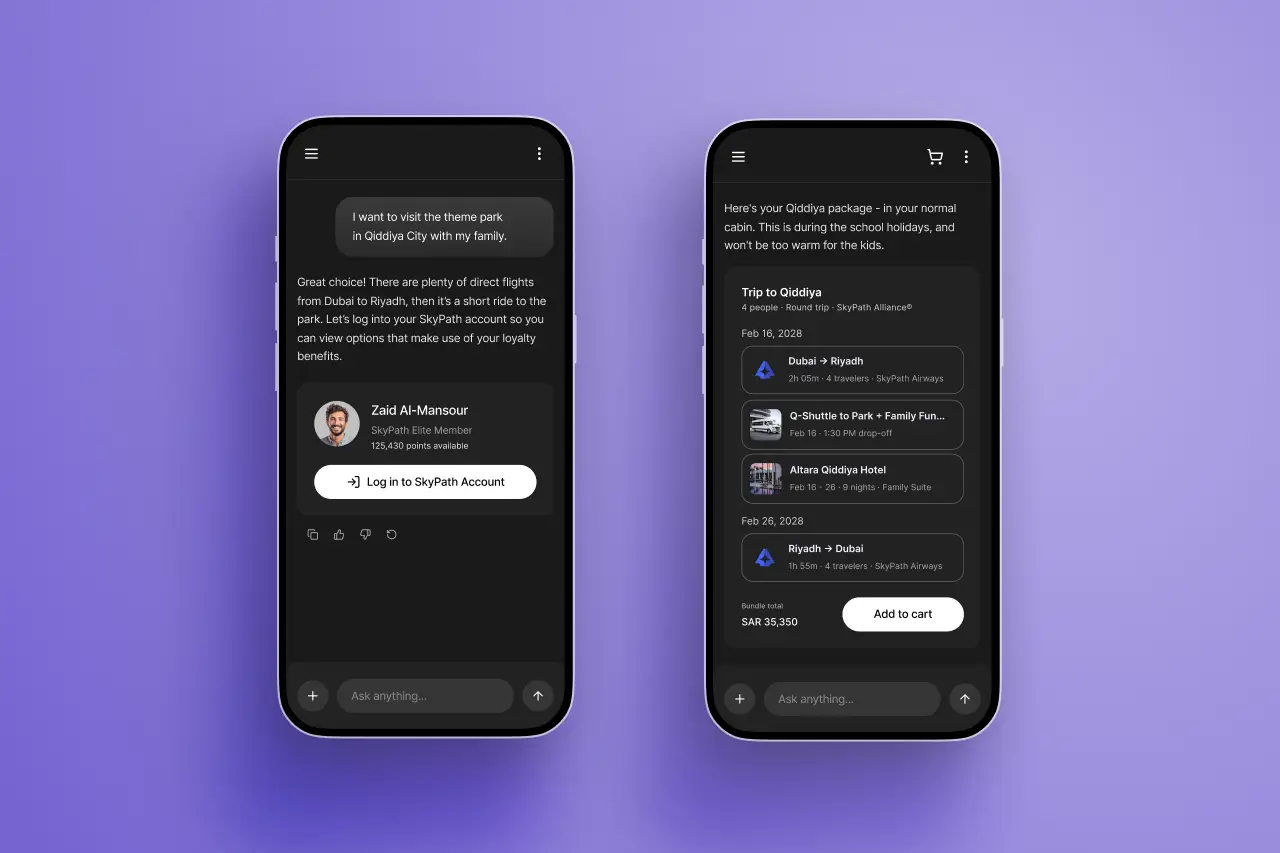
In a well-designed agentic experience, a traveler’s intent carries forward rather than starting over at each step. They explore possibilities without committing. Plans change. Preferences emerge gradually. A disruption triggers an adjustment, not a rebuild. The system understands what has already happened and why.
Shopping, booking, changes, and service all reference the same underlying context. Nothing is re-entered. Nothing is reconstructed.
That continuity depends on a persistent commercial record, where products, prices, conditions, and entitlements evolve on a single record rather than being reassembled with every interaction.
The experience feels effortless because the system maintains continuity, and continuity is exactly what most airline systems were never designed to provide.

Offers and orders change the equation
Offers and orders don’t make AI smarter. They make airline systems usable by AI.
By design, ONE Order treats offers and orders as complete, structured objects. Products, prices, conditions, entitlements, and servicing rules live together in a single record. Changes update that record directly. Fulfillment and accounting read from the same source.
Instead of requiring AI to stitch together availability from one system, pricing from another, and servicing logic from a third, the airline exposes a single, consistent commercial record.
Exploration becomes actionable. Iteration becomes reliable. Service becomes part of the same flow as selling, and the potential of agentic travel moves from theoretical to operational.
APIs built for autonomy and service, not just browsing
Being “AI-ready” isn’t about adding a conversational layer to an existing booking flow. It means exposing services that autonomous systems can use without breaking state, losing context, or forcing everything back through a human-shaped path.
In practice, that requires:
- APIs that support iteration without resetting
- Services that expose options, conditions, and outcomes in real time
- The ability to move seamlessly between shopping and servicing – pricing, holding, changing, and repricing within the same object
FLYR’s Offer & Order platform provides a stable commercial core. Orchestration determines how intelligence is applied across selling, change, and fulfillment. Together, they allow AI systems to plan, act, and adjust without fragmenting the traveler’s journey.

Our design principles in practice
Architecture alone is not enough. This is where FLYR’s design principles extend the foundation.
Removing the Friction: Modular services let AI systems explore, book, change, and service without triggering downstream rework or vendor handoffs.
→ Rebooking today often means rebuilding intent across availability, pricing, fare rules, ticketing, and ancillaries – sometimes across multiple vendors. With a persistent Order, changes apply to the same commercial record. Reaccommodation becomes a transition, not a restart.
Data You Can Work With: Structured Orders provide reliable inputs and traceable outcomes across shopping and servicing, so decisions improve without guesswork.
→ Refunds break down when entitlements are implicit or fragmented across systems. A structured Order keeps fare rules, ancillary rights, and service history explicit – so refund eligibility and penalties can be derived consistently, reducing disputes and manual reconciliation.
Building for an AI World: Open APIs, clear ownership, and predictable behavior let autonomy scale without introducing operational risk.
→ Automation becomes risky when commercial intent and financial settlement diverge. Predictable APIs and a single commercial record ensure servicing actions reflect consistently in downstream systems – making automation auditable, reversible, and safe to scale.
Why this matters now
Agentic systems will gravitate toward platforms that allow them to complete tasks end-to-end – including changes and servicing. When APIs impose resets, handoffs, or blind spots, agents and customers find alternatives elsewhere.
Airline success in the AI arena won’t be defined by model sophistication. It will be defined by whether the foundations allow intelligence to sell and serve without friction.
Building for an AI world starts with the right infrastructure, and we’re building it here at FLYR.
Learn more at flyr.com.
The post Building for an AI World: The Architecture Behind Autonomy appeared first on FLYR.